
Going Solo

You think you can do it all. You think you can keep going and going and going until it’s the end of December, you take huge breath, and realize that just this once you might have overdone it.
I knew I’d hit the wall when, at a New Years Eve party, I danced to every single song whether anyone else was dancing or not. Five straight hours. It was a giant unwind.
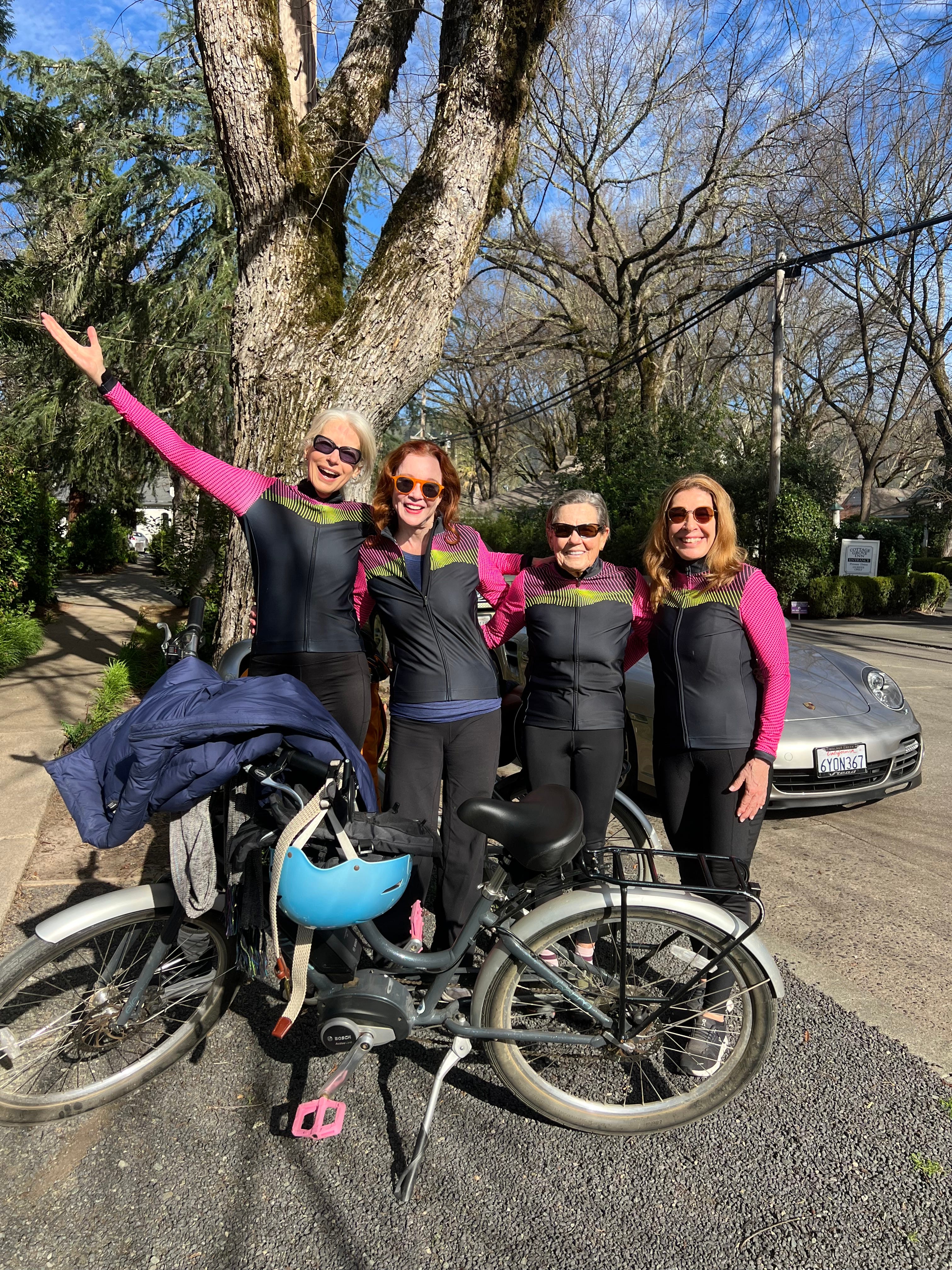
Still, 2025 turned out to be a great year. Biking (here we are, the Cycling Sisterhood of St Helena!) kept me sane when Come Over October got crazy. Crazy in a good way. Last year, the grassroots pro-wine movement I co-founded with Gino Colangelo and Kimberly Charles reached 2.6 billion consumers in press coverage and another 5.6 million on social media. It was the kind of pro-bono project that takes over your life. But not giving back to wine, not giving back to the industry that has given so much to me? It wasn’t an option.
One of my favorite times during the campaign was when I interviewed P!ink, the singer songwriter and vintner (Two Wolves Wine) who had heard about Come Over October and wanted to support it. I was just plain blown away by the beauty and clarity of her passion for wine.
The whole thrust of COO is that wine brings us together—an especially poignant fact now when loneliness and social isolation are at epidemic levels, according to the US Surgeon General. Wine is inherently a communal beverage. You probably don’t share a can of beer or a margarita with someone else. But you do share a bottle of wine. Wine has played this cohesive communal role for centuries.
And yet, for as many times as I’ve said the words in the paragraph above, I know that those words are missing something.
They are missing a radical shift in how and when we relate to other people. For decades, Americans consistently spent about 6.5 hours a week with friends, according to the Harvard Kennedy School. Then, between 2014 and 2019, that number plummeted to just 4 hours per week. Now it’s down to just over 2 hours a week.
People are simply alone more. Which doesn’t always mean they are lonely. So I’ve been thinking a lot about what I call Wine Solo—drinking wine when you are by yourself, happily by yourself. Wine, at times like that, becomes a fascinating joy, a tiny delicious way to enrich the moment.
I don’t mean drinking wine to “drink.” In fact, to me, the most intoxicating thing about wine is not the alcohol. It’s the way wine moves in your mouth, the velocity and fluidity of its choreography. I’m intoxicated by its scent—sometimes, if it’s red, by seductive primordial smells I can’t name; and if it’s white, I sometimes feel like I’ve jumped into a pool of lemons. I am intoxicated by the mind trip of wine—that it can transport you to places you’ve never been, and places you don’t want to forget. And I’m intoxicated by its power to make you follow what it is “saying.” The way I sometimes think about it, a delicious wine drinks you; you don’t drink it.
I don’t want to lose any of this just because I am by myself.
As an aside, The New York Times predicts that in 2026 Solo dining will emerge as self care; that a quiet dinner alone will increasingly be seen as a spa-like respite.
On another front, I was in Texas recently, a place I have complicated feelings about (it’s probably an old boyfriend thing). Anyway I have always thought of Texas as a place that’s big on wine. In Houston and Dallas, I’ve been in several private wine cellars, the values of which exceeded the GDPs of many countries.
So there I was at a wealthy ranch, talking with a man who was drinking something out of a red plastic cup. “I love tequila,” he offered with what seemed like special fondness.
“What do you like about it?” I asked.
“It’s just so pure, so clean,” he said, and then pointing at my glass of Sauvignon Blanc, he added: “And it doesn’t have any sugar like wine.”
I groaned inside. “But 99% wine doesn’t have any sugar,” I countered.
He waved over a group of his friends. “How much sugar is there in wine?” he asked the group.
The responses ranged from 11% to 50%.
What???? How did this happen? How did wine, seemingly out of nowhere, get a reputation as being full of sugar? In a recent Wine Market Council study, 75% of the more than 1200 wine-drinking consumers polled said that knowing the sugar content of the wine was important in deciding whether or not to choose to drink a wine!!!
The poll then asked: Where do you believe the sugar in wine comes from? 53% said sugar is added to wine in the production process. 36% said sugar substitutes are added during winemaking.
Holy god.
That’s all I have to say about this (for now).
On a happier note, I went to Champagne for a week early last year. I need no reason to fall in love with Champagne. I drink a glass of Champagne every night as it is. (A Champagne stopper that keeps bubbles in—now there’s one of life’s necessities). I have no other indulgences except Champagne. And compared to clothes, it’s a much more affordable indulgence.
What did I learn? I learned something I maybe already knew. That Champagne is a state of mind. That it is equal parts joy and discipline. Equal parts science and intuition. Equal parts sensory experience and spirituality. Champagne is endless and enduring.
I also went to Cava country in northeastern Spain in Catalonia. Another place I love. (And another boyfriend story that will not be told). I was astounded. The sheer number of small artisanal producers making Cava (Spain’s sparkling wine) has exploded. And the wines are fantastic. In quality and sophistication, they are lightyears away from the big commercial Cava brands that have dominated the market for decades. I have a lot of hope for these small Cava producers. They are doing everything right. I’ve made several travelogue videos about them, the wines, and the trip. Here’s one of those videos.
There’s more to share. I will write again soon. Thank you for reading this far, and if you want to read more of my stuff, consider signing up for my weekly newsletter WineSpeed. You can right HERE.
Gratefully, Karen
This myth about sugar in wine comes from the apparently successful- but false - advertising campaigns for “dry” wines, low sugar wines etc. .
Some group of real winemakers need to counter with their own social media advertising campaign.
In this new world the things we thought we could take for granted like folks know wine doesn’t have sugar you can’t take for granted. Folks believe social media unfortunately. This is how Trump got elected.
Thank you everyone. What amazing comments. A writer lives for her readers.